
















Digital Mailroom + Paper-to-EDI Continuity Checklist
By Vidhya Bhat, Chief Product Officer, Digital Transformation, Imagenet
If a third-party cyber incident is disrupting intake, payer operations cannot afford workaround-heavy processes that reduce visibility and control. In most cases, this is not a full work stoppage—teams keep operating—but leaders start reassessing operational risk, redundancy, and long-term exposure.
In this blog, I outline a practical continuity checklist to validate digital mailroom intake controls and pinpoint where a contingency-ready bridge can stabilize throughput under disruption. It reflects real-world payer environments with mixed channels (mail, fax, email, portals, and electronic feeds) and a core dependency on compliant, accurate paper-to-EDI conversion and downstream transmission.
What Continuity Requires
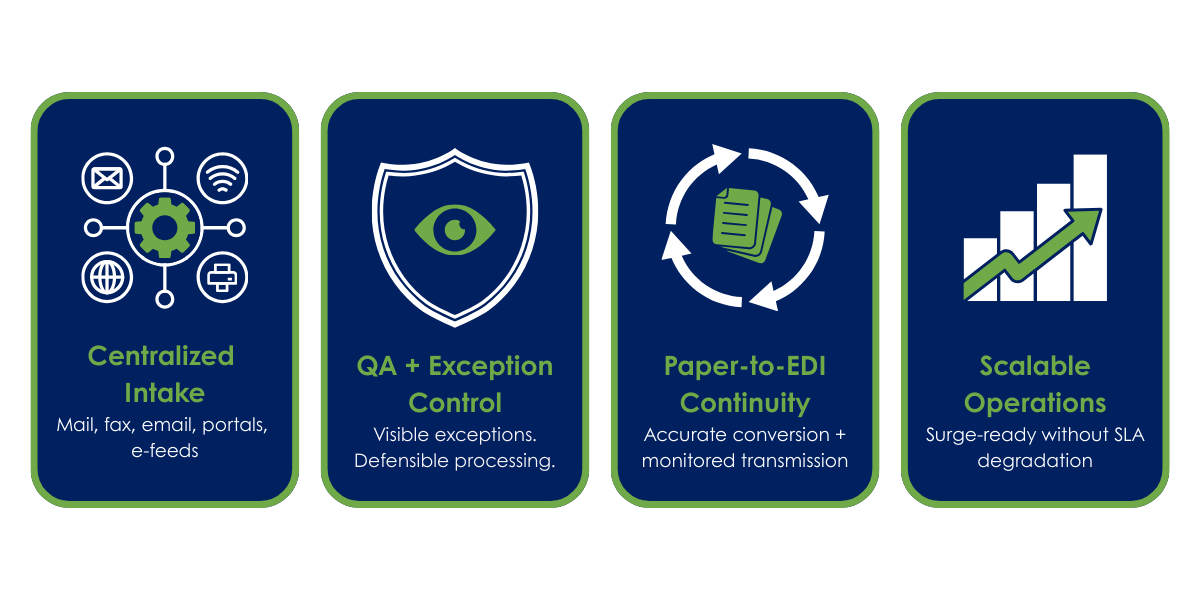
Governed intake. Controlled processing. Reliable paper-to-EDI throughput. Scalable operations.
What “Continuity” Should Mean in a Post-Incident Environment
Continuity is the ability to keep intake moving with predictable throughput, defensible processing, and audit-ready traceability—even when volumes surge or a vendor constraint introduces friction. Practically, that requires:
-
Centralized channel intake into one governed pipeline (mail, fax, email, portals, e-feeds).
-
Disciplined QA and controlled exception handling to reduce rework and prevent downstream contamination.
-
Paper-to-EDI conversion controls that protect outbound EDI data quality and transmission reliability.
-
Operational scalability under surge conditions without SLA degradation.
Digital Mailroom + EDI Continuity Checklist: 10 Controls to Validate
These controls are written so you can use them as an internal checklist. If a control is partially true, capture the gap and the mitigation.
1) Centralize intake across channels into a controlled pipeline
Confirm that mail, fax, email, portals, and electronic feeds are routed into a single governed workflow with standard intake rules and clear ownership. Avoid one-off inboxes and ad hoc handoffs that create blind spots during disruption.
2) Anchor on paper-to-EDI continuity (conversion + downstream transmission)
Validate that paper-originating claims and supporting documents can be converted to EDI accurately and transmitted downstream with monitored acknowledgements. Define validation rules, transmission checkpoints, and escalation paths so EDI output stays compliant and reliable under stress.
3) Implement governed exception handling (no “mystery work”)
Require that all low-confidence items, missing data, and format anomalies enter a controlled exception queue with disposition codes, SLAs, and audit trails. This keeps exceptions visible and prevents silent backlog accumulation.
4) Standardize data validation and QA checkpoints
Define field-level validation rules and QA sampling plans that are defensible and repeatable. Use confidence thresholds, dual-control for high-risk fields, and traceable correction workflows to protect downstream adjudication and reporting.
5) Maintain end-to-end traceability and audit-ready controls
Ensure each item is trackable from receipt through processing and delivery, with timestamped events, user actions, and version history. At minimum, confirm document control numbers (DCNs) or equivalent identifiers and searchable audit logs.
6) Design for surge scalability without SLA degradation
Document how you absorb incremental volumes—staffing flex, queue-based prioritization, batching, and parallelized processing—without compromising QA. Make surge playbooks explicit, not tribal knowledge.
7) Protect intake security and access governance
Confirm role-based access, secure authentication, and controlled data handling for PHI. Where required, validate SSO/MFA alignment, segmentation of duties, and evidence-ready controls that support security and compliance reviews.
8) Validate redundancy and single-point-of-failure exposure
Map your operational dependencies (sites, vendors, systems, integrations) and confirm you have a tested path to shift workload if any component degrades. Multi-site capability and geographic redundancy reduce risk concentration.
9) Operationalize continuous improvement in accuracy and exceptions
Track exception drivers, correction patterns, and turnaround time trends. Use AI/ML-enabled automation where applicable to improve extraction accuracy, reduce avoidable exceptions, and continuously optimize cost and cycle time.
10) Confirm governance, stability, and compliance posture
Ensure you can articulate your governance model, long-term investment commitment, and compliance posture (e.g., HITRUST i1® where applicable). In post-incident environments, stability and oversight matter as much as speed.
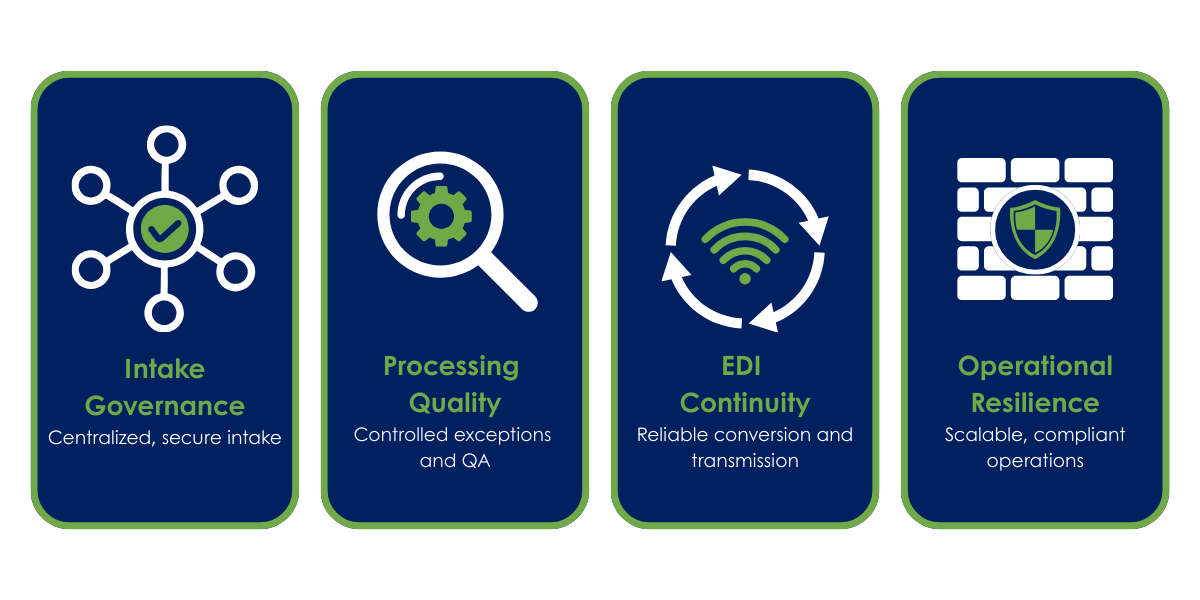
10 Continuity Controls, 4 Core Focus Areas
How To Use This Checklist
For each control above, label your current state as one of the following:
- Confirmed and consistently executed
- Partially in place (gap documented)
- Not in place (risk accepted or mitigation required)
If you identify gaps in controls 1–4 (centralization, EDI continuity, exception governance, QA/validation), prioritize those first. They typically drive the fastest gains in visibility, accuracy, and operational stability.
Next Step: Pressure-Test Intake + EDI risk
If you are reassessing intake risk after a third-party incident, a targeted review can quickly surface single points of failure, EDI exposure, and the controls required to stabilize throughput under surge. Imagenet is positioned as a lower-risk, scalable, future-ready (AI/ML-enabled) alternative—built for governed intake, defensible processing, and audit-ready controls.
Frequently Asked Questions
What is digital mailroom continuity for healthcare payers?
Digital mailroom continuity is the ability to keep intake channels moving with predictable throughput, controlled processing, and audit-ready traceability when disruptions occur. For healthcare payers, this often means maintaining visibility and control across mail, fax, email, portals, and electronic feeds while protecting downstream claims and operational workflows.
Why does paper-to-EDI continuity matter during a third-party disruption?
Paper-to-EDI continuity matters because paper-originating claims and supporting documents still need to be converted accurately and transmitted downstream, even when a vendor constraint or cyber incident creates operational friction. Without monitored validation rules, acknowledgement checkpoints, and escalation paths, payers risk delays, rework, compliance issues, and downstream adjudication problems.
What controls should healthcare payers validate in their digital mailroom operations?
Payers should validate controls around centralized intake, paper-to-EDI conversion, exception handling, QA, audit traceability, surge scalability, access governance, redundancy, continuous improvement, and compliance oversight. The most urgent gaps are often in intake centralization, EDI continuity, exception governance, and validation because those areas directly affect visibility, accuracy, and operational stability.
How can payers reduce risk in paper-to-EDI workflows?
Payers can reduce risk by centralizing intake into a governed workflow, applying field-level validation rules, monitoring outbound EDI transmissions, tracking acknowledgements, and routing low-confidence items into controlled exception queues. These controls help prevent “mystery work,” reduce downstream contamination, and create a more defensible audit trail.
When should a healthcare payer reassess its digital mailroom and EDI continuity strategy?
A payer should reassess its digital mailroom and EDI continuity strategy after a third-party incident, vendor disruption, volume surge, SLA pressure, or any operational event that exposes limited visibility, manual workarounds, or single points of failure. A targeted review can help identify intake risk, paper-to-EDI exposure, and the controls needed to stabilize throughput.