
















Digital Mailroom Governance: 7 Questions Payer Leaders Should Ask After Go-Live
In the first article in this two-part series, we outlined 10 questions payer leaders should ask before a digital mailroom goes live. This follow-up focuses on what comes next: the governance needed to monitor performance, manage operational risk, address change, and maintain accountability after implementation. Without a defined governance model, queue growth, recurring exceptions, and workflow changes can remain unresolved until they affect turnaround times or downstream operations.
Go-live does not eliminate the need for active oversight. Payer teams still need visibility into document volumes, turnaround times, queue inventory, exceptions, quality, downstream delivery, and emerging workflow risks.
Requirements will also continue to change. New document types, business rules, systems, regulatory priorities, and volume patterns may require the digital mailroom operation to adapt over time.
Payers should ask the following seven questions when evaluating a post-go-live governance model.
1. What operating cadence will keep performance visible?
A defined operating cadence helps the payer and digital mailroom partner review the right information at the appropriate level.
During initial stabilization, more frequent discussions may be required to review throughput, queue depth, exceptions, open issues, and corrective actions. Once the operation reaches a steady state, governance can move into a structured schedule of operational, performance, and executive reviews.
Each forum should have a specific purpose.
Operational reviews may focus on:
- Current inventory
- Turnaround-time performance
- Exceptions
- Open issues
- Near-term volume or workflow changes
- Open action items, owners, and due dates
Broader performance reviews may address:
- Trends over time
- Root causes
- Continuous-improvement opportunities
- Upcoming business events
- Strategic priorities
The goal is not to create unnecessary meetings. It is to ensure that issues are visible to the appropriate stakeholders before they create larger operational impacts.
2. Which measures should be included in digital mailroom reporting?
Digital mailroom reporting should show more than the number of documents processed.
Payer teams need enough information to understand where work is located, how quickly it is moving, and where performance may be breaking down.
Relevant reporting may include:
- Intake volume by channel and document type
- Queue inventory and aging
- Throughput and processing rates
- Turnaround-time and SLA performance
- Classification and extraction outcomes
- Exception volume and reason trends
- File or transmission failures
- Reconciliation results
- Quality trends
- Downstream delivery status
- Open corrective actions
- Root-cause trends by issue or exception type
Reporting should support both oversight and improvement. For example, recurring exceptions may indicate that a business rule, classification model, document source, or routing configuration needs attention.
Payers should also ask whether reporting can be segmented by document type, line of business, source, workflow status, or other operationally relevant attributes.
3. How will operational issues be escalated?
Escalation paths should be defined before an issue occurs.
Routine questions may begin with a program manager, account contact, or designated support resource. Issues that remain unresolved, recur, or begin affecting turnaround times should move to operations leadership. Matters involving compliance, service continuity, regulatory exposure, or material client impact may require executive involvement.
The governance model should clarify:
- Who receives the initial notification
- What conditions trigger escalation
- Who owns communication
- How often updates are provided
- How remediation actions are documented
- How progress is tracked through closure
- How issue severity or priority is determined
Clear escalation paths help the parties respond according to operational impact rather than relying on informal relationships or ad hoc decision-making.
4. How are different types of incidents managed?
Not every issue presents the same degree of operational risk.
A complete processing interruption requires a different response from an isolated error, reporting question, or non-urgent configuration request.
For incidents involving electronic PHI, the HIPAA Security Rule requires regulated entities to identify and respond to known or suspected security incidents, mitigate harmful effects, and document the incident and its outcome.
A digital mailroom governance model should distinguish among issues such as:
- Complete intake or processing disruption
- Significant degradation affecting throughput
- Failure of a major classification or routing process
- Exception growth that may create future SLA exposure
- Isolated errors with a documented workaround
- Non-urgent reporting or configuration requests
For each category, payers should understand:
- Who owns the response
- Who must be notified
- How the issue is tracked
- What update cadence applies
- How corrective action is documented
- When root-cause analysis is required
The objective is to apply a consistent, governed response that reflects the severity and operational impact of the issue.
5. How will backlog risk be identified and addressed?
Backlog management should begin before an SLA or turnaround-time commitment is missed.
Potential risk may be identified through:
- Queue monitoring
- Volume reconciliation
- Throughput trending
- Exception-volume analysis
- Inventory aging
- Comparison of current queues against approaching deadlines
Real-time queue visibility and audit reporting can help teams identify aging inventory, exception buildup, and SLA risk before performance deteriorates.
When a backlog risk emerges, the governance process should define how the affected work will be assessed, prioritized, and communicated.
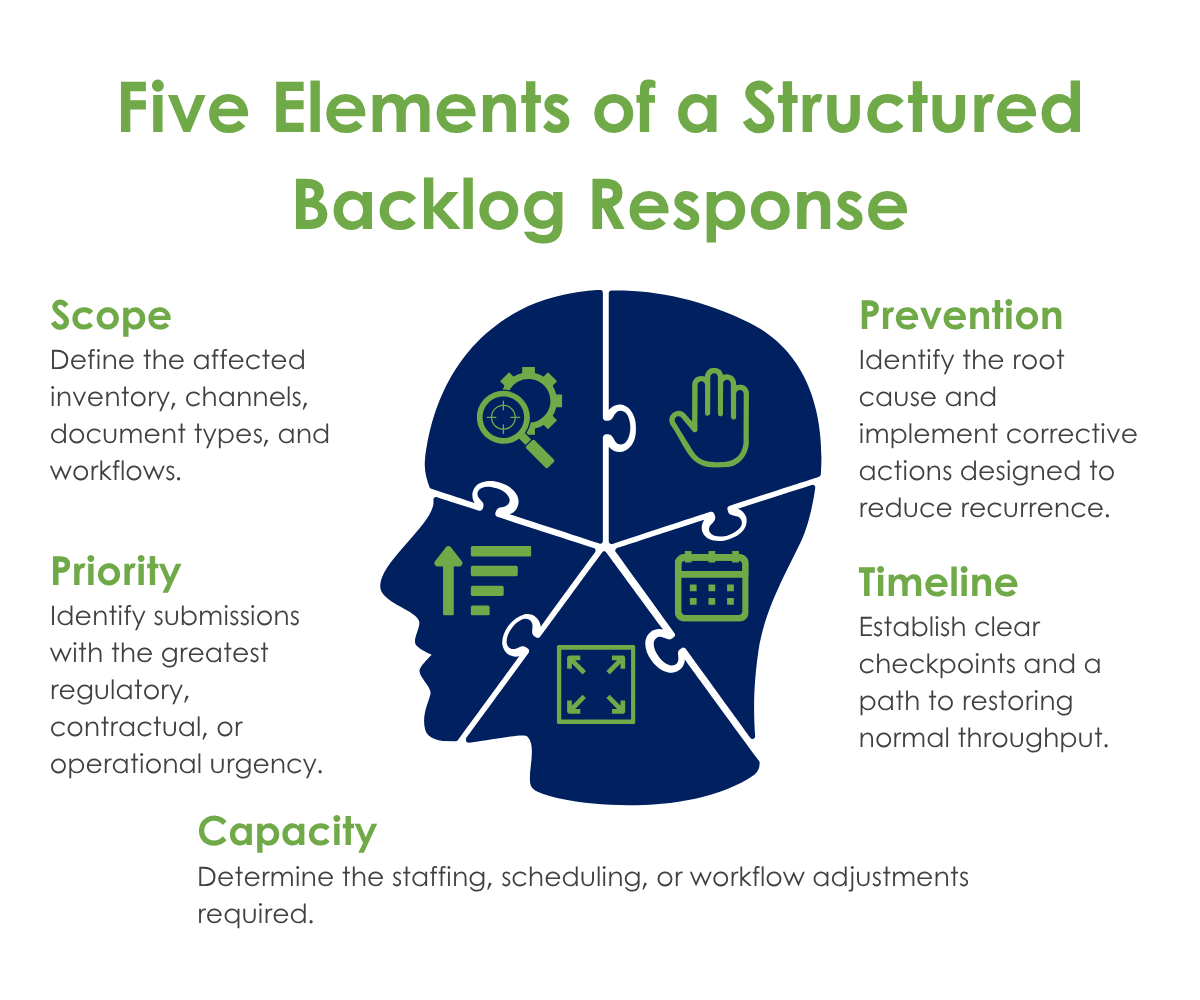
Payers should also ask how known business events, seasonal volume changes, or shifts in document mix are incorporated into capacity planning.
6. How will workflow changes be evaluated and controlled?
Digital mailroom workflows need to adapt as business requirements change. Governance responsibilities may also vary by delivery model, including managed, hybrid, and software-only approaches.
Potential requests may include:
- Adding document types
- Updating classification rules
- Changing index fields
- Revising routing logic
- Creating new exception queues
- Adjusting turnaround-time tiers
- Adding intake channels
- Updating roles or permissions
- Expanding reporting
- Connecting additional downstream systems
The governance model should distinguish between configuration changes and custom development.
Configuration changes use established platform and workflow capabilities. Custom development may be required when a request cannot be supported through existing configuration.
Regardless of category, changes should follow a controlled process that may include:
- Request intake
- Requirements review
- Operational and security impact assessment
- Documentation and approval
- Non-production testing
- Payer validation where appropriate
- Controlled production deployment
- Post-deployment monitoring
- Change-log documentation
This structure allows the digital mailroom to evolve while protecting production stability, security, and auditability.
7. Who is accountable for continuous improvement?
Continuous improvement requires named ownership and measurable outcomes.
Operational stakeholders should be responsible for reviewing performance, monitoring exceptions, resolving open issues, and advancing corrective actions. Executive stakeholders should maintain visibility into material risks, broader performance trends, partnership health, and strategic priorities.
Improvement opportunities may emerge from:
- Recurring exception patterns
- Routing issues
- Quality trends
- Changes in document volume
- Turnaround-time performance
- New business requirements
- Downstream system changes
- Client or user feedback
Each initiative should have:
- A clearly defined issue or opportunity
- A named owner
- Required actions
- A target timeline
- A measurable outcome
- A method for reporting progress
Without defined ownership, improvement discussions can remain open without producing operational change.
Governance Keeps the Digital Mailroom Visible and Adaptable
A digital mailroom should not operate as a static or isolated intake function.
It must remain connected to downstream workflows, payer priorities, compliance requirements, and changing operating conditions. A clear governance model provides the structure needed to monitor performance, identify risks, manage changes, and maintain accountability.
For payers, the central question after go-live is not simply whether documents are being processed. It is whether the operation remains controlled, transparent, and capable of adapting as requirements evolve.
How Visible and Controlled Is Your Intake Operation?
Use Imagenet’s Digital Mailroom Readiness Checklist to assess workflow routing, exception handling, reporting, governance, SLA controls, and opportunities for operational improvement.