

















Is Your Member Communications Technology Reducing Complexity — or Adding to It?
Technology is supposed to make Member Communications easier to manage. But adding systems, automating individual tasks, or digitizing existing processes does not necessarily create a simpler operating environment.
For payer teams, the more useful question is not simply what technology is in place? It is how effectively does that technology support the work?
That distinction matters as Member Communications moves across benefit and regulatory inputs, content development, approvals, data, translation, accessibility, production, fulfillment, and delivery. Technology may support individual stages of that lifecycle while still leaving teams to manually bridge the gaps between them.
The real test is whether technology reduces operational burden — or simply moves that burden somewhere else.
What Technology That Reduces Complexity Should Do
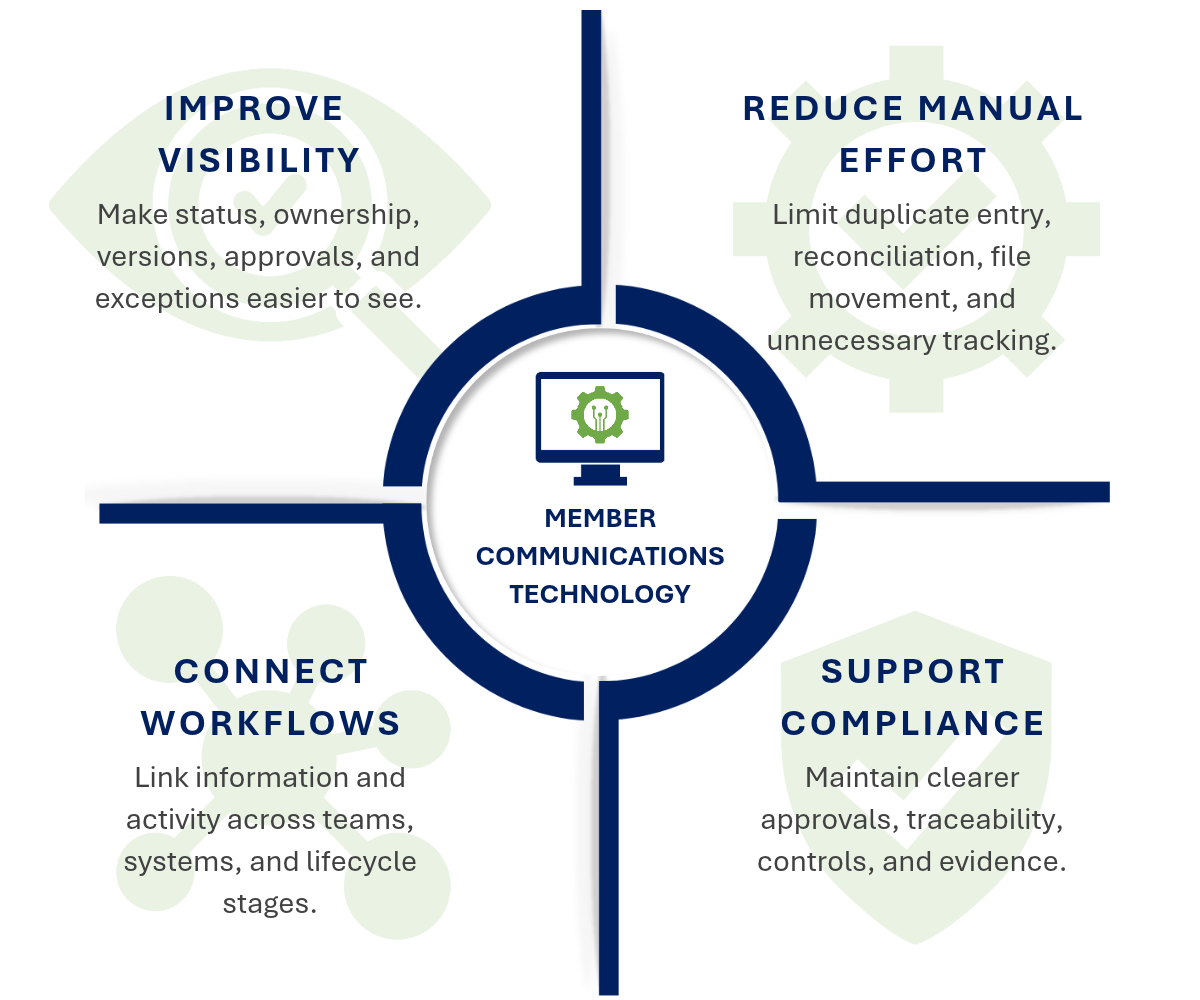
The right technology environment should make the work easier to see, coordinate, and control. Four outcomes are particularly useful to consider.
Improve Visibility
Can teams see where work stands, who owns the next action, which version is current, what has been approved, and where an issue needs attention?
Technology should make those answers easier to find. When status information is spread across systems, inboxes, trackers, and vendor portals, the operational burden of maintaining visibility shifts back to the people doing the work.
Reduce Manual Effort
Not every manual step is unnecessary. Human judgment remains important across regulated communications.
The question is whether teams are spending time on work that exists primarily because systems are not connected: duplicate data entry, file transfers, repeated reconciliation, manual status updates, or copying information between tools.
Removing those workarounds can create capacity without removing the expertise or controls the process requires.
Connect Workflows
Member Communications is not one isolated workflow. Benefit data may influence content. Content changes may affect translation or accessibility. Approvals influence production readiness. Production and mailing activity ultimately feed delivery and compliance evidence.
Technology creates more value when it helps connect those dependencies rather than optimizing one task while leaving the handoffs around it unchanged.
Support Compliance
Compliance should not depend on reconstructing what happened after the fact.
Technology can support a stronger control environment when approvals, versions, decisions, and required evidence are easier to trace throughout the workflow. The goal is not simply more documentation. It is having the right documentation available as part of the process rather than creating it manually when an audit, review, or issue arises.
When Technology Starts Adding Complexity Instead
The opposite pattern can be easy to normalize because individual workarounds often develop for understandable reasons.
A new tracker is created because the primary system does not provide enough visibility. A manual reconciliation step is added because two systems produce different information. Another tool is introduced to solve a specific problem, but the existing tool remains in place. Teams develop email-based processes to bridge gaps between formal workflows.
Each workaround may solve an immediate problem. Collectively, they can create an operating environment that requires increasing effort simply to keep the work coordinated.
Some signals worth examining include:
- Disconnected systems that require information to be moved or reconciled manually
- Duplicate tools serving overlapping purposes
- Parallel spreadsheets or trackers used to create missing workflow visibility
- Manual workarounds that have become permanent parts of the process
- Multiple sources of truth for content, data, status, or approvals
- Technology that automates an individual task but leaves surrounding handoffs unchanged
None of these automatically means a system should be replaced. They are signals that the total effort required to operate the technology environment deserves a closer look.
The Real Test: Does Technology Reduce Coordination Burden?
A technology environment can be technically functional and still create operational complexity.
That is why the strongest measure of technology is not simply whether it automates something. It is whether the overall operating model becomes easier to manage as a result.
Can teams spend less time reconciling information? Can they identify issues earlier? Can they see ownership and status without maintaining a parallel process? Can work move across functions without repeatedly being reconstructed, reentered, or revalidated?
Technology should help connect the operating model — not become another layer that the operating model has to manage.
And technology is only one dimension of the equation. People, process, data, vendors, and controls all influence whether Member Communications can operate efficiently and with the visibility payer teams need.
See the Operating Model Behind Your Member Communications Technology
Assess technology alongside people, process, data, vendors, and controls to identify where unnecessary complexity, manual effort, or disconnected workflows may be creating operational burden.