
















How Payer Operations Shape Member and Provider Experience
Member and provider experience is often judged by what happens at the surface: a notice received, a claim processed, a call answered, a question resolved, or a provider interaction completed.
But the quality of those experiences depends on the operational structure underneath.
For healthcare payers, every interaction is shaped by the data, routing, timing, visibility, communications, rules, and support capacity behind it. When those elements work well, members and providers are more likely to receive clear, timely, and consistent service. When they do not, the result can look like a service problem: a delayed answer, a confusing notice, a repeat call, a claims issue, or an unresolved provider inquiry.
Improving member and provider experience requires operational readiness across the connected functions that support the experience, including intake, claims, communications, fulfillment, and contact center support.
Better Experiences Depend on the Structure Underneath
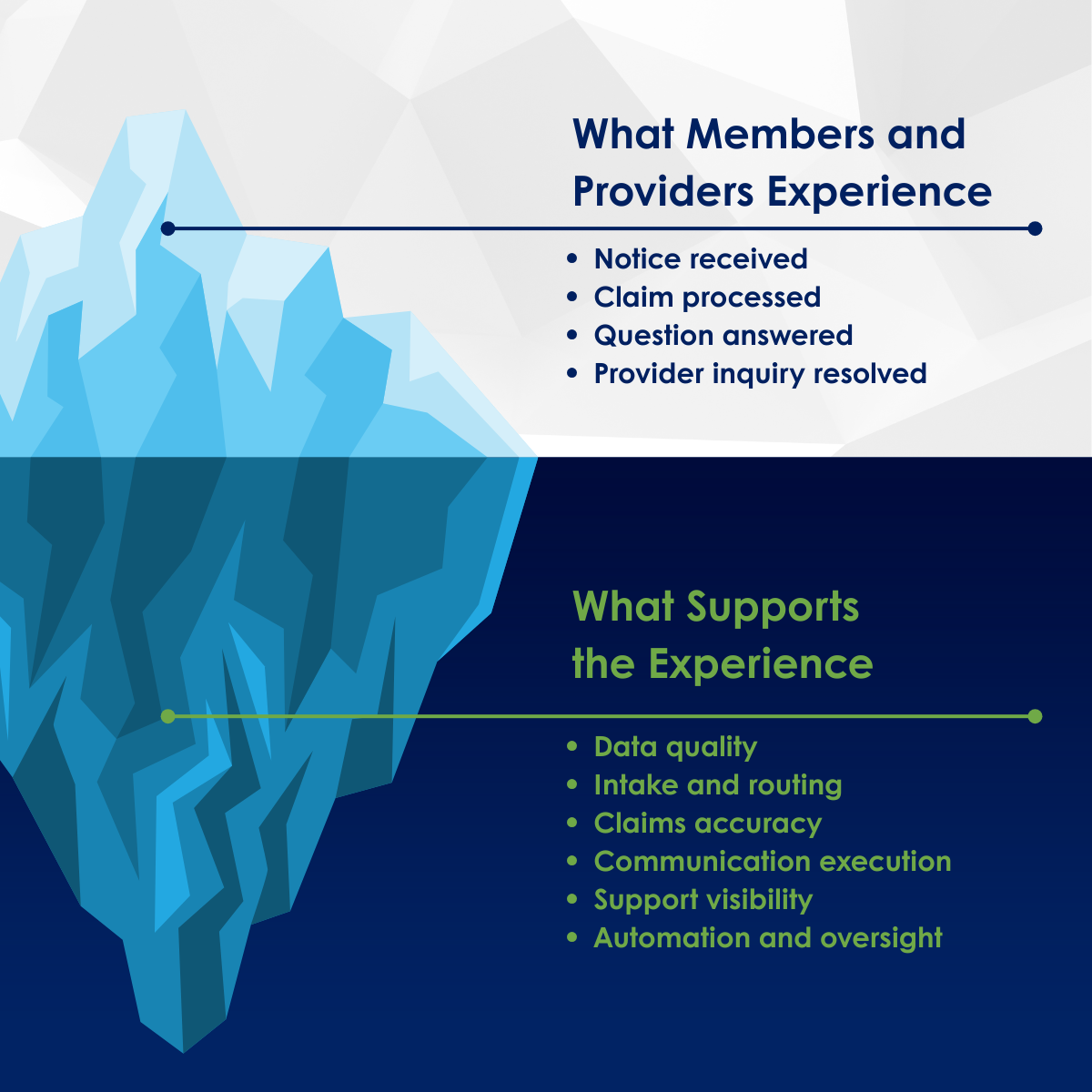
The surface-level experience is what members and providers see. They receive a letter, call with a question, wait for a claim to process, respond to an eligibility request, or contact the plan for help.
Behind those moments are many operational dependencies. A member communication may rely on accurate source data, approved templates, accessibility requirements, translation needs, fulfillment, and timing rules. A provider inquiry may depend on claim status, documentation, routing, and visibility across teams.
When the structure underneath is fragmented, manual, or inconsistent, teams spend more time researching issues, correcting data, rerouting work, answering repeat questions, or explaining delays that could have been prevented earlier in the process.
For payers, the question is not only how to improve the interaction itself. It is also what operational conditions are shaping that interaction before it reaches the member or provider.
Where Experience Friction Shows Up Across Payer Operations
Experience friction rarely stays contained to one department. A small issue in one part of the operation can create pressure elsewhere, especially when information moves across systems, teams, vendors, and channels.
1. Intake Issues Create Downstream Delays
Many payer processes begin with incoming information: mail, faxes, forms, images, digital files, claims-related documents, appeals, enrollment materials, provider correspondence, and other unstructured or semi-structured inputs.
If that information is incomplete, misclassified, delayed, or difficult to extract, the impact can move downstream quickly. Teams may need to correct data, search for missing information, reroute work, or pause processing until the right documentation is available.
For members and providers, that may show up as a delay, an unclear status, a request for additional information, or a longer support interaction.
Clean intake is not just an operational efficiency issue. It is part of the experience foundation.
2. Claims Complexity Affects Provider Trust and Member Confidence
Claims accuracy, turnaround time, and exception handling have a direct impact on provider experience. Providers notice when claims are delayed, denied unexpectedly, require avoidable rework, or lack clear status visibility.
Members can feel the impact as well. A claims issue may surface through an explanation of benefits, a bill, a delayed service resolution, or a call to the plan for help understanding what happened.
When claims operations are slowed by manual processes, exception backlogs, inconsistent rules, or limited visibility, the experience becomes more difficult for everyone involved.
3. Communication Gaps Create Confusion and Repeat Contacts
Member communications are one of the clearest places where operational execution becomes visible.
A notice that is late, confusing, inconsistent, inaccessible, or disconnected from what support teams are prepared to explain can quickly create frustration and increase inbound volume.
Communication pressure often rises during moments such as benefit changes, eligibility checks, renewal-related updates, plan or program transitions, enrollment changes, and other high-volume communication periods. In those moments, accuracy and timing matter. So do accessibility, translation, version control, fulfillment, and coordination with member support teams.
4. Support Teams Carry the Burden of Disconnected Operations
Contact center and support teams often absorb the impact of operational gaps that start elsewhere.
Members and providers may call because a notice was unclear, a claim status is confusing, a document is missing, a prior interaction did not resolve the issue, or a process requires action they do not fully understand.
When contact center teams have the right visibility, guidance, and capacity, they can resolve questions more consistently. When they do not, representatives may need to research across systems, escalate more often, or provide partial answers, creating more callbacks and longer resolution times.
5. High-Volume Moments Expose Weak Handoffs
High-volume periods do not usually create operational gaps from nothing. They reveal where the operation is already fragile.
Open enrollment, AEP, benefit changes, eligibility-related updates, renewal communications, regulatory changes, claims volume spikes, service disruptions, and program transitions can all increase pressure on payer teams.
When handoffs are unclear, data quality is inconsistent, staffing is stretched, or communications are not coordinated, issues that are manageable at normal volume can become larger experience problems.
What Operational Readiness Looks Like in Practice
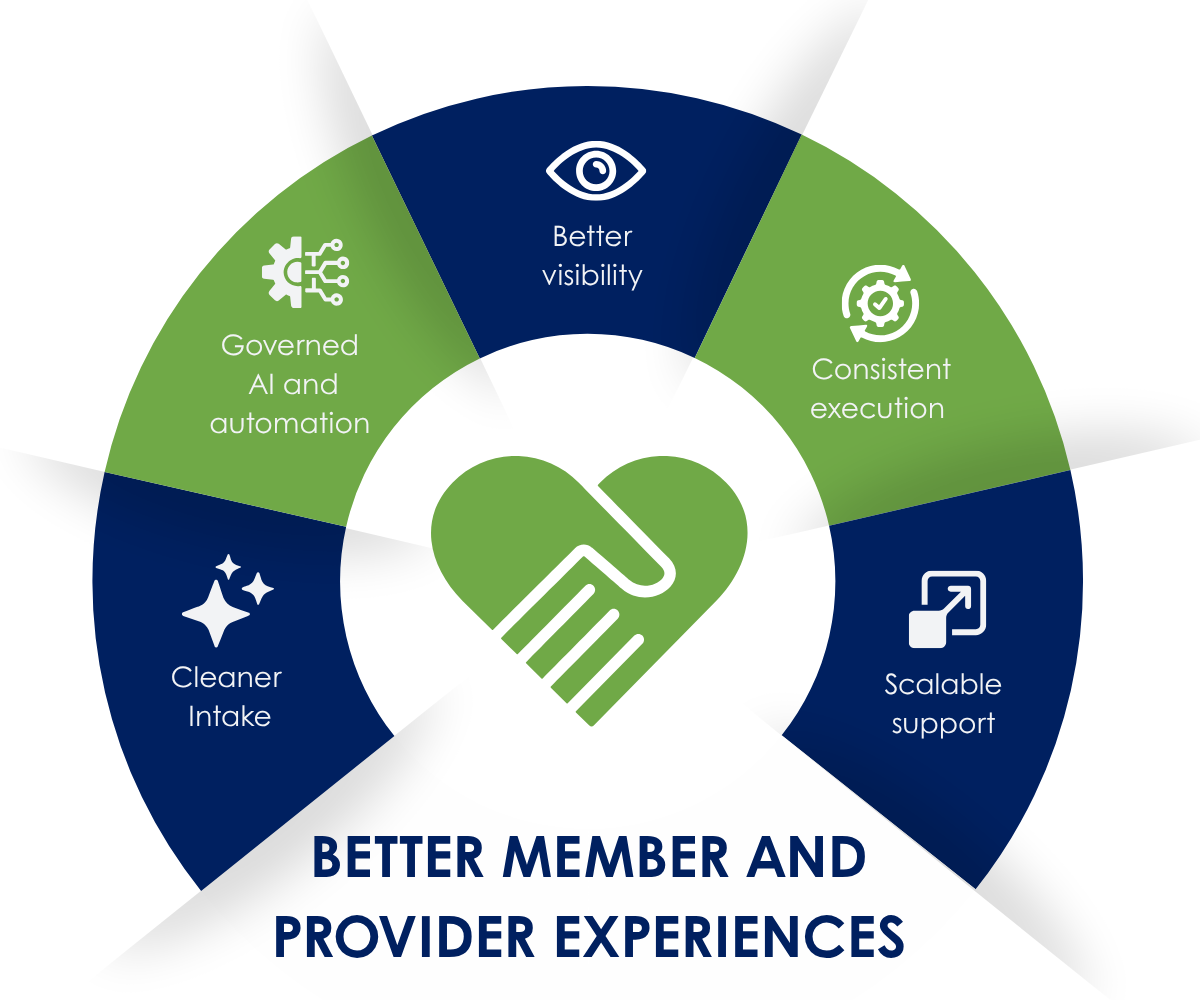
Operational readiness is the ability to manage the support areas behind member and provider interactions with speed, accuracy, consistency, visibility, and control.
It does not always require a full transformation. Payers can often start by identifying where friction is showing up and strengthening the areas with the greatest impact on experience.
Cleaner Starting Points
Better downstream outcomes begin with cleaner information at the start. That means incoming documents and digital files are classified correctly, relevant data is extracted accurately, exceptions are identified early, and work is routed to the right place.
Better Visibility Across Connected Functions
Experience problems become harder to resolve when teams cannot see what happened upstream. Visibility into status, ownership, delays, exceptions, and handoffs helps teams understand what needs action and respond more consistently.
More Consistent Execution
Payers manage complex rules, communications, service expectations, and compliance requirements. Standardized processes, templates, business rules, quality controls, and oversight help reduce variation and make execution more reliable.
Scalable Support Capacity
Member and provider needs are not static. Operational readiness includes the ability to scale capacity during enrollment periods, benefit changes, eligibility updates, claims surges, and other shifts without sacrificing accuracy, responsiveness, or service quality.
Governed Use of AI and Automation
AI and automation can help payers improve speed and scalability across areas such as classification, extraction, routing, quality checks, knowledge support, and operational visibility.
But AI works best when it is supported by clear rules, clean data, validation, oversight, and domain expertise. The goal is not automation for its own sake. It is stronger, more consistent execution in the areas that shape member and provider experience.
A Timely Example: Eligibility Changes and Continuity-of-Coverage Support
Eligibility and renewal-related changes show how quickly operational readiness can become a member experience issue.
In California, upcoming six-month eligibility checks for certain Medi-Cal adults may create more frequent moments where members need to respond to maintain coverage. The state remains responsible for eligibility determinations, but plans that enroll Medi-Cal-eligible members may still need to verify and act on eligibility status changes.
While plans don't own the formal eligibility determination process, these changes may still create downstream member experience impacts, including enrollment or disenrollment activity, member questions, increased communication needs, accessibility and language needs, contact center volume, outreach coordination, and continuity-of-coverage concerns.
For affected members, the stakes may be significant. If they do not respond to the process, they could risk losing coverage.
This is one example of a broader operational reality: when policy, eligibility, benefit, or program changes affect members, the experience depends on how clearly and consistently the supporting operations respond.
Questions Payer Leaders Can Ask Now
Payer leaders can begin by asking:
- Where do member or provider issues most often require rework, callbacks, or manual research?
- Which incoming documents, files, or data sources create the most downstream cleanup?
- Are claims exceptions, inquiries, and communications connected clearly enough for teams to respond consistently?
- During high-volume periods, which teams feel pressure first?
- Where could automation improve speed or consistency, and where is human oversight still essential?
These questions can help payers identify the support areas where operational improvements may have the greatest impact on member and provider experience.
Strengthen the Operations Behind Better Experiences
Better member and provider experiences are built through many operational moments.
A claim that processes accurately. A notice that arrives on time. A support representative who can answer with confidence. A provider inquiry that does not require repeated follow-up. A member who understands what action to take and when.
Those moments depend on the structure underneath: the data, processes, communications, technology, staffing, automation, and oversight that keep payer operations moving.
Ready to Strengthen the Operations Behind the Experience?
Explore how Imagenet helps healthcare payers improve the speed, accuracy, and consistency of member and provider interactions.
Learn More
Frequently Asked Questions
How do payer operations affect member and provider experience?
Payer operations affect member and provider experience by shaping how quickly, accurately, and consistently information moves across intake, claims, communications, and support. When these connected functions are coordinated, members and providers are more likely to receive clear answers, timely updates, and reliable service.
What is operational readiness for healthcare payers?
Operational readiness is the ability to manage payer operations with the right data, processes, technology, staffing, automation, and oversight. For member and provider experience, it means having the structure in place to respond effectively across everyday operations, high-volume periods, and moments of change.
Where does friction usually show up in payer operations?
Friction often shows up in unstructured intake, manual data correction, claims exceptions, delayed or confusing communications, limited visibility across teams, and support interactions that require repeat calls or manual research. These issues may start behind the scenes, but they can quickly become visible member or provider experience problems.
How can AI support better member and provider experiences?
AI can support better member and provider experiences by helping payers classify documents, extract data, route work, identify exceptions, support quality review, and improve consistency at scale. However, AI works best when it is part of a governed operational model that includes validation, oversight, business rules, and payer-trained expertise.
How can health plans improve member and provider experience without replacing every system?
Health plans can start by identifying where friction is showing up most often and strengthening the operational areas behind those interactions. That may include improving intake quality, claims accuracy, communication execution, support visibility, or capacity during high-volume periods. Targeted operational improvements can help improve speed, consistency, and reliability without requiring a full system replacement.